
Ukraine Lessons Relevant for Tairāwhiti

12:00 AM Wed 01 April 2026

Ukraine may be a world away from Gisborne but Tairāwhiti Emergency Management group manager Ben Green could see plenty of similarities after presenting at the inaugural Australia-New Zealand-Ukraine Cooperation Forum.

The decorated former New Zealand Defence Force major was invited through New Zealand’s Ukraine Association to offer a Kiwi lens on emergency management.

The trilateral event brought together practitioners, leaders and experts to focus on the foundations of enduring partnership - security, systems and state capacity.

The forum kicked off with pre-event discussions in Warsaw with the Polish Investment and Trade Agency (PAIH) attended by New Zealand Ambassador to Poland Paul Ballantyne as well as embassy staff from Australia and Ukraine.

Green said it set the scene for political, economic and strategic context and relationship-building before heading to Lviv, Ukraine, for the core forum.

“The things we are doing here in emergency management is of interest to them like emergency communications and disaster water treatment units. They are in a constant state of response while, for us, the comparison is more around catastrophic risk planning.”

The trip gave an insight into emergency in a different context while also highlighting points of connection with Tairāwhiti.

“This is a country that has been at war for four years,” Green said. “What is relatable is that our challenge is adapting to what Mother Nature throws at us. Tairāwhiti’s exposure to natural hazards have impacted our whānau and environment ... that is a very different kind of risk to what people in Ukraine face in a war zone, but there are still lessons in resilience, preparedness and adaptation.”

Green funded the trip himself and was part of the panel discussion around emergency response.

“It was awesome to be there. There were NGOs, civil and military personnel. There were also a lot of New Zealand tech companies. Anything in the drone space working with the Ukrainians is from New Zealand and Australia.

“The whole procurement cycle has to be agile enough to remain adaptive with just how fast technology is changing in the drone space. If you are not adapting within three months, you are out of date.

“Ukraine has developed its industrial and technology system. They do not want handouts, but rather licensing agreements to manufacture in lieu of waiting for other nations to send support,” Green said.

Some of the technology had dual use and could easily roll through to emergency management in New Zealand.

“There was very much an overriding sense that the country is preparing for post-conflict recovery,” Green said. “They are not waiting for the conflict to end.”

The nation had to adapt and evolve in all aspects, he said.

“They are constantly looking at the complexities of supporting a population that is in a very technological war zone where your critical lifelines are constantly being targeted.

“Their national grid is getting smashed every night, so they are looking at a number of different options for energy sources to remove the risk associated with being reliant on a national grid.”

Green met a number of Kiwis who were actively involved in the conflict, others who were working with NGOs dealing with humanitarian relief and evacuations of people, and a raft of other specialists.

There were some incredible initiatives, including a woman who had evolved the identification of remains forensically to connect families with their deceased loved ones, and an Australian radiographer who was investigating a way to treat veterans who had lost limbs and were badly affected by phantom nerve pain (pain felt in a missing or amputated limb).

“It was very sobering that every day we were there, there were military funerals.

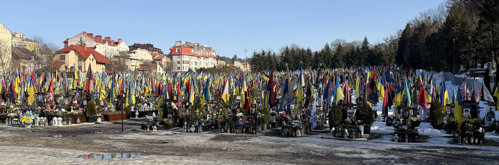
“I made a point of going to the veterans’ cemetery to pay my respects. The people of Ukraine have a very loyal sense that no one is forgotten or left behind. Every day at 9am the whole country stops for a minute’s silence to honour those who have died. It is the price of freedom for Ukraine.”

Green visited the 1610-built church where military funerals are run.

“There are photographs of all the veterans there ... so many that there is almost not enough room in the church for them.”

Green has previously been in three war zones but said the Ukraine war was different.

“This is what modern warfare looks like, with precision attacks and such a scale of scope of conflict. Ukrainian resolve and innovation are second to none.”
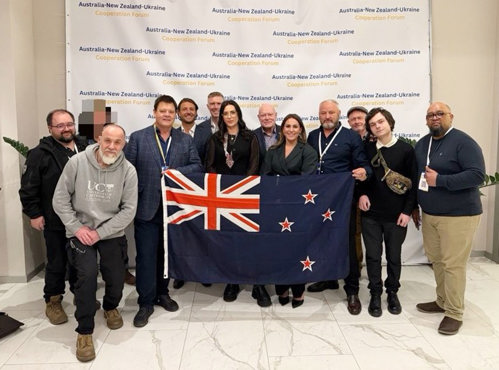


Ben Green (fourth from right) at the recent inaugural Australia-New Zealand-Ukraine Cooperation Forum in the Ukraine.


Ukraine may be a world away from Gisborne but Tairāwhiti Emergency Management group manager Ben Green could see plenty of similarities after presenting at the inaugural Australia-New Zealand-Ukraine Cooperation Forum.

The decorated former New Zealand Defence Force major was invited through New Zealand’s Ukraine Association to offer a Kiwi lens on emergency management.

The trilateral event brought together practitioners, leaders and experts to focus on the foundations of enduring partnership - security, systems and state capacity.

The forum kicked off with pre-event discussions in Warsaw with the Polish Investment and Trade Agency (PAIH) attended by New Zealand Ambassador to Poland Paul Ballantyne as well as embassy staff from Australia and Ukraine.

Green said it set the scene for political, economic and strategic context and relationship-building before heading to Lviv, Ukraine, for the core forum.

“The things we are doing here in emergency management is of interest to them like emergency communications and disaster water treatment units. They are in a constant state of response while, for us, the comparison is more around catastrophic risk planning.”

The trip gave an insight into emergency in a different context while also highlighting points of connection with Tairāwhiti.

“This is a country that has been at war for four years,” Green said. “What is relatable is that our challenge is adapting to what Mother Nature throws at us. Tairāwhiti’s exposure to natural hazards have impacted our whānau and environment ... that is a very different kind of risk to what people in Ukraine face in a war zone, but there are still lessons in resilience, preparedness and adaptation.”


Ben Green visited the veterans cemetery to pay his respects.


Green funded the trip himself and was part of the panel discussion around emergency response.

“It was awesome to be there. There were NGOs, civil and military personnel. There were also a lot of New Zealand tech companies. Anything in the drone space working with the Ukrainians is from New Zealand and Australia.

“The whole procurement cycle has to be agile enough to remain adaptive with just how fast technology is changing in the drone space. If you are not adapting within three months, you are out of date.

“Ukraine has developed its industrial and technology system. They do not want handouts, but rather licensing agreements to manufacture in lieu of waiting for other nations to send support,” Green said.

Some of the technology had dual use and could easily roll through to emergency management in New Zealand.

“There was very much an overriding sense that the country is preparing for post-conflict recovery,” Green said. “They are not waiting for the conflict to end.”

The nation had to adapt and evolve in all aspects, he said.

“They are constantly looking at the complexities of supporting a population that is in a very technological war zone where your critical lifelines are constantly being targeted.

“Their national grid is getting smashed every night, so they are looking at a number of different options for energy sources to remove the risk associated with being reliant on a national grid.”

Green met a number of Kiwis who were actively involved in the conflict, others who were working with NGOs dealing with humanitarian relief and evacuations of people, and a raft of other specialists.

There were some incredible initiatives, including a woman who had evolved the identification of remains forensically to connect families with their deceased loved ones, and an Australian radiographer who was investigating a way to treat veterans who had lost limbs and were badly affected by phantom nerve pain (pain felt in a missing or amputated limb).

“It was very sobering that every day we were there, there were military funerals.

“I made a point of going to the veterans’ cemetery to pay my respects. The people of Ukraine have a very loyal sense that no one is forgotten or left behind. Every day at 9am the whole country stops for a minute’s silence to honour those who have died. It is the price of freedom for Ukraine.”

Green visited the 1610-built church where military funerals are run.


The church built in 1610 where the military funerals are run which houses photographs of all the veterans . . . there so many that there is almost not enough room in the church for them all.


“There are photographs of all the veterans there ... so many that there is almost not enough room in the church for them.”

Green has previously been in three war zones but said the Ukraine war was different.

“This is what modern warfare looks like, with precision attacks and such a scale of scope of conflict. Ukrainian resolve and innovation are second to none.”